
The Roman bath in Olympos - Turkey
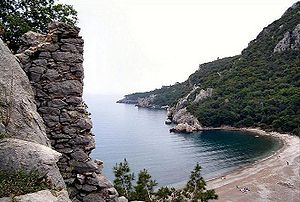
The beach in Olympos - Turkey
Olympos is an ancient city which is located in a valley at the south coast of
Turkey, 90 km southwest of
Antalya city near the Town of
Kumluca.
The former city of Olympos was founded in the
Hellenistic period, presumably taking its name from nearby Mount Olympos (
Turkish:
Tahtalı Dağı, Timber Mountain), one of over twenty mountains with the name Olympos in the Classical world.
From these mountains of the Solymi, according to Homer, the god Poseidon looked out to sea and saw Odysseus sailing away from Calypso's island, and called up a great storm that wrecked him on the shores of the island of
Nausicaa.
[1]
The coins of the city of Olympos date back to the 2nd century BC. It was described by Cicero as an ancient city full of riches and works of art.
[2] The city became one of the six leading cities of the
Lycian federation. In the 1st century BC, Olympos was invaded and settled by
Cilician pirates. This ended in 78 BC, when the Roman commander
Publius Servilius Isauricus, accompanied by the young Julius Caesar, took the city after a victory at sea, and added Olympos to the
Roman Empire. The pirate Zenicetes set fire to his own house and perished.
[3] The emperor
Hadrian visited the city after which it took the name of Hadrianopolis for a period, in his honour.
The chief deity of Olympos was
Hephaestus, god of fire and blacksmiths. Near Olympos, located in the neighbouring village of
Çıralı and about 200 meters above sea level, the
eternal flames called the
Chimaera may be seen issuing from the ground. The fuel source for the flames is natural gas, largely
methane, seeping through cracks in the earth. The mythical
Chimaera - or Chimera - was a monster with the head of a lion, the body of a goat and the tail of a serpent, who roamed these woods and sprouted fire from her mouth.
In the
Middle Ages,
Venetians,
Genoese and
Rhodians built two
fortresses along the coast, but by the 15th century Olympos had been abandoned. Today the site attracts tourists, not only for the artifacts that can still be found (though fragmentary and widely scattered), but also for its scenic landscapes supporting wild grapevines, flowering oleander, bay trees, figs and pines.
Activities
The Olympos village is located in the heart of the Olympos coastal national park. The surrounding area offers best conditions for Trekking, Mountain biking, Canyoning, Rock climbing, Sea kayaking. It is possible to rent equipment in the village or to join organized tours.


 History and Cultural heritage, Turkey is a door of amazing possibilities world. Turkey is a magnificent place for meetings, incentive and congresses where Europe and Asia meets.


 Taurus moutains with an elevation of at least 1000m height, are quite cool even in the summer and the people of Antalya and the nomadic Yoruk people spend their summers up here. The primary highland villages are Bakirli, Feslegen, Yesil Yayla and Saklikent.
